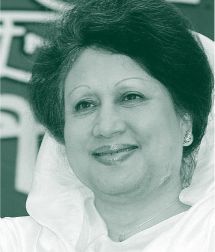
BNP Chairperson & Former Prime Minister (1945–2025)
Begum Khaleda Zia is the Chairperson of the Bangladesh Nationalist Party (BNP), who served three times as the Prime Minister of Bangladesh from 1991. She was the first woman Prime Minister of Bangladesh and the second elected woman head of government in the Muslim world.
Early Life & Family
Begum Zia was born on 15 August 1946 in Dinajpur district to Iskandar Majumder and Taiyaba Majumder. Her ancestral home is in Feni, a south-eastern district of the country. She studied at Dinajpur Government Girls' High School and later at Surendranath College. In 1960 she married Ziaur Rahman.
When Ziaur Rahman Bir Uttam became the President of Bangladesh, Begum Zia, as First Lady, met world leaders including British Prime Minister Margaret Thatcher and Queen Juliana of the Netherlands.
Entry into Politics & the Uncompromising Leader
After the martyrdom of President Zia in 1981, she joined the BNP as an ordinary member on 2 January 1982. She was elected Vice-Chairman of the party in March 1983 and Chairperson in August 1984.
After General Ershad's military coup in 1982, Khaleda Zia launched an all-out movement to restore democracy. She was the architect of the seven-party alliance formed in 1983. Because of her firm determination, she was detained seven times between 1983 and 1990. For her uncompromising opposition to Ershad's military autocracy, she earned the reputation of the "Uncompromising Leader" (Aposhheen Netri).
First Woman Prime Minister
On 27 February 1991, through a free and fair election, Begum Zia was elected the country's first woman Prime Minister. During her term Bangladesh returned to a parliamentary democracy. Employment grew significantly—in the ready-made garment sector alone, employment rose by 29% over five years, and about two hundred thousand women joined the sector during this period.
She raised the issue of Ganges water-sharing at the United Nations so that Bangladesh would receive a fair share of the water. Invited to the White House in 1992, she raised the problem of Rohingya Muslim refugees, and Myanmar later signed a repatriation agreement with Bangladesh.
Second Term & Alliance Politics
After the BNP's victory in 1996, Khaleda Zia became Prime Minister for a second consecutive term, but to keep her promise of establishing a caretaker-government system she resigned within a month. In the election of June 1996 the BNP won 116 seats, becoming the largest opposition party in the history of Bangladesh.
In 1999, under her leadership, the BNP formed a four-party alliance and won the 2001 election on a pledge to eradicate corruption and terrorism. In 2005, Forbes magazine ranked her 29th on its list of the most powerful women in the world for her role in women's education and empowerment.
Contribution to Education & Electoral Record
While in power, Khaleda Zia's government made substantial progress in education by introducing compulsory free primary education, free education for girls up to class ten, a stipend for female students, and a 'food for education' programme. The entry-age limit for government jobs was raised from 27 to 30 years, and the highest budget allocation was made for the education sector.
Begum Zia holds the unique record of never being defeated in any constituency. In the general elections from 1991 to 2001 she was elected from five separate parliamentary seats, and in 2008 she won all three seats she contested.
Struggle for Democracy & Passing
From 2009, when the government led by Sheikh Hasina turned Bangladesh into an authoritarian state, she renewed her struggle for democracy. The government forcibly evicted her from her home and placed her under house arrest more than once. For her role in defending democracy, the New Jersey State Senate honoured her with the title "Fighter for Democracy" in 2011.
Begum Khaleda Zia, Chairperson of the Bangladesh Nationalist Party (BNP) and former Prime Minister, passed away on 30 December 2025. She will be remembered forever in the love of millions of people.